

Going Back in Time: A History of Printing Across the Centuries. - 20th Century
- Nov 29, 2017
- 4 min read
Hi,
I hope you all are having a good day. This post continues into the history of printing in the 20th Century.
Twentieth century
In 1903 American printer Ira Washington Rubel is instrumental in producing the first lithographic offset press for paper. In offset presses a rubber roller transfers the image from a printing plate or stone to the substrate. Such an offset cylinder was already in use for printing on metals, such as tin.
In 1907 the Englishman Samuel Simon is awarded a patent for the process of using silk fabric as a printing screen. Screen printing quickly becomes popular for producing expensive wallpaper and printing on fabrics such as linen and silk. Screen printing had first appeared in China during the Shang Dynasty (960–1279 AD).
A few of the new press manufacturers that appear on the market are Roland (nowadays known as Man Roland) in 1911 and Komori Machine Works in 1923.
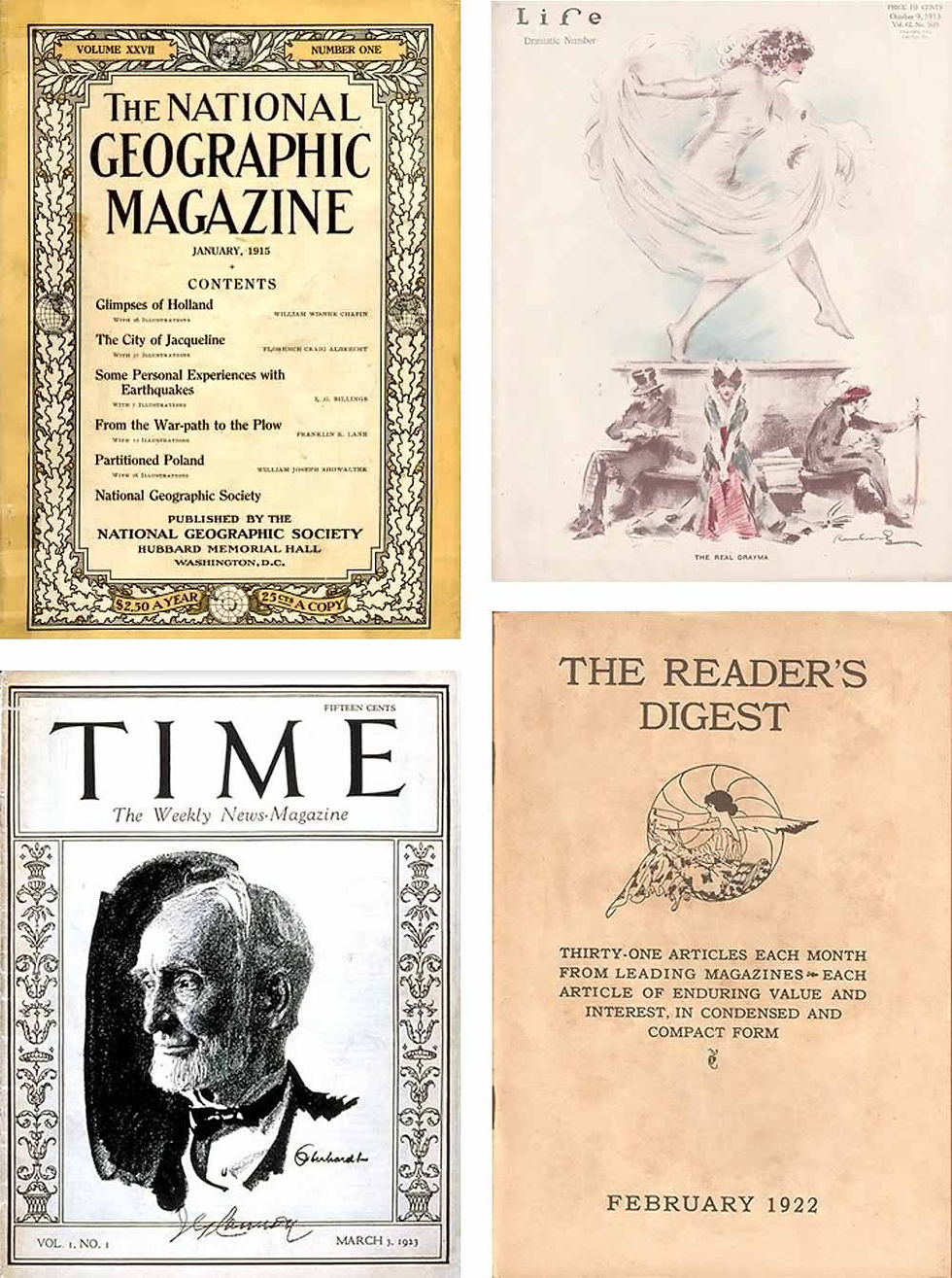
In 1915 Hallmark, founded in 1910, creates its first Christmas card. It is during this same era that magazines such as the National Geographic Magazine (1888), Life (1883, but focussing on photojournalism from 1936), Time (1923), Vogue (1892) and The Reader’s Digest (1920) starting reaching millions of readers.
Press manufacturer Koenig & Bauer launch the four-color Iris printing press in 1923. It can be used for printing banknotes. Over time security printing becomes one of the main focus points of the company.
The first commercially successful series of paperback books is published by Penguin Books in the UK in 1935. Earlier in 1931 German publisher Albatross Books had already tried to market a series of lower-priced books with a paper cover and glue binding. Penguin copied many of the concepts of their failed attempt, such as the use of color-coded covers.
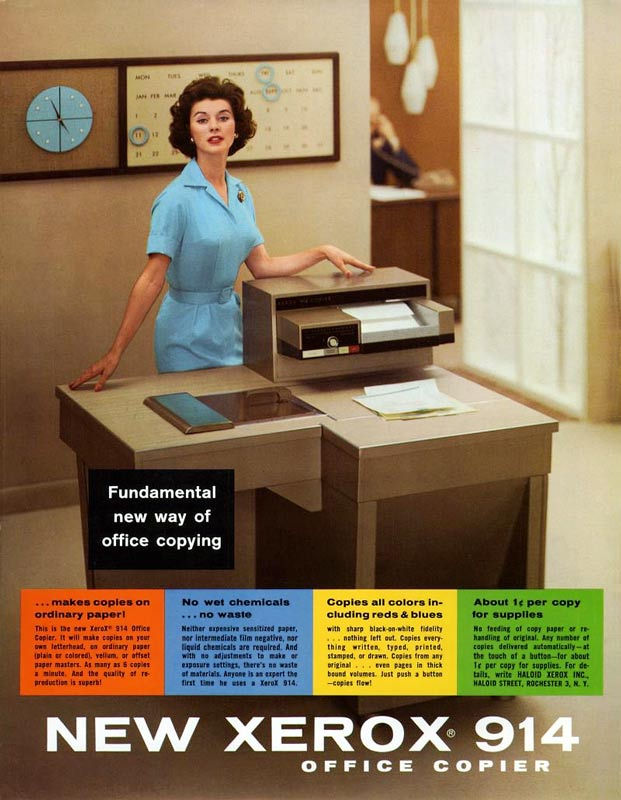
In 1938 Xerography, a dry photocopying technique is invented by Chester Carlson. The first commercial xerographic copier is introduced in 1949 but it is the 1959 Xerox 914 plain paper copier that is the breakthrough.
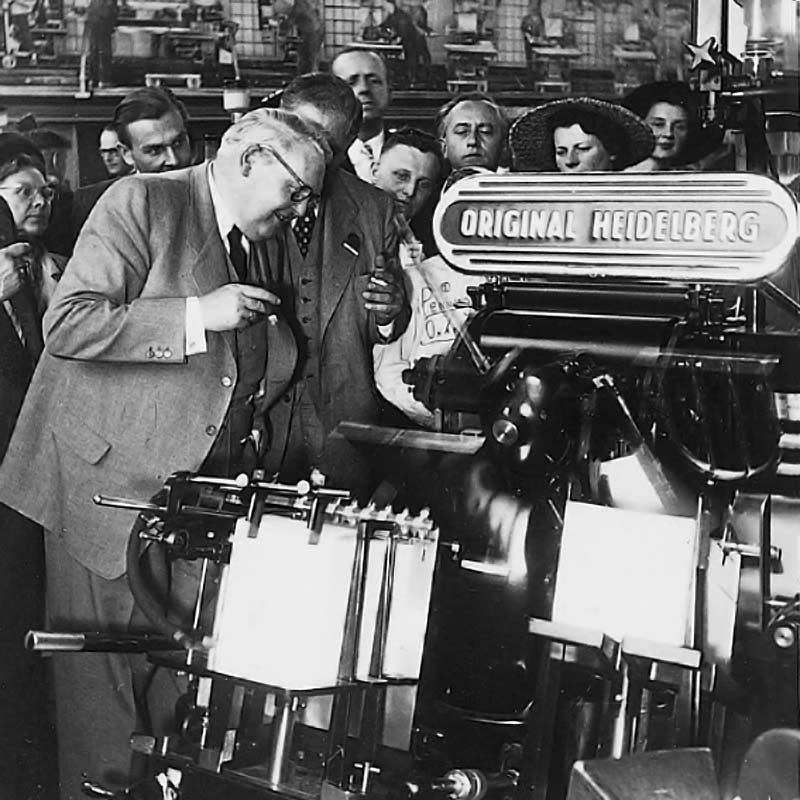
Japanese machine tool manufacturer Shinohara Machinery Company begins manufacturing flatbed letterpress machines in 1948. A popular press from that time is the Heidelberg Tiegel. The picture below shows it being demonstrated to German finance minister Ludwig Erhard at the first drupa trade show in 1951.
In 1967 the ISBN or International Standard Book Number started. This is a unique numeric identifier for commercial books. That same year Océ enters the office printing market with an electro-photographic process for copying documents using a special chemically-treated type of paper.
New materials like silicone make it possible for manufacturers such as Tampoprint to build more efficient presses for printing on curved surfaces. Pad printing can now be done on an industrial scale.
In the USA newspaper circulation reaches its highest level ever in 1973. It will remain fairly steady until a gradual decline sets in during the mid-’80s.
The first laser printers, such as the IBM 3800 and Xerox 9700, hit the market in 1975. They are prohibitively expensive but useful for applications such as cheque printing.
Desktop publishing takes off in 1985. The combination of the Apple Macintosh computer, printers and imagesetters powered by Adobe PostScript and the layout application Aldus PageMaker makes publishing more affordable.
At drupa 1986 MAN Roland Druckmaschinen AG introduces its LITHOMAN commercial web offset printing press. Polar show off the POLAR Compucut, a system for computer-assisted, external generation of cutting programs with automatic transfer to the cutting machine.
The Xerox Docutech, launched in 1990, combines a 135 page-per-minute black & white xerographic print engine with a scanner and finisher modules. It is arguably the first affordable print-on-demand publishing system.
In 1992 Australia is the first country to use polymer banknotes for general circulation.
Digital printing takes off in 1993 with the introduction of the Indigo E-Print 100.
Colour printing

As early as 1457 a psalter, which Peter Schöffer signed but which some researchers now attribute to Gutenberg, included, in imitation of the contemporary illuminated manuscripts, paragraphs beginning with ornamental capital letters printed in two colours. This was accomplished by the use of two wood blocks that fitted one inside the other and could be separately inked.Experiments to reproduce pictures in several colours on wood blocks were made in Germany in the 16th century. In the 17th century, different inks were applied to the different parts of the same engraved metal plate in such a way that all the inks were transferred to the paper in a single pressing. In 1719 a painter, Jacques-Christophe Le Blond, took out a patent in England for a process that used the three primary colours, blue, yellow, and red, and black for outlining shapes. Using a dense grid, he engraved four metal plates, bringing out on each plate the relative importance of the colour involved. The same sheet of paper then went through four successive impressions, each in a different colour.In the 19th century the scientific definition of the principles of trichromatism, the enunciation of the fundamental theories of three-colour analysis and synthesis of colours by photography, the perfecting of coatings selectively sensitive to colours, and finally the use of the screen, instead of Le Blond’s hand-drawn grid, established the modern trichromatic technique (which becomes quadrichromatic when black is also used).
Stayed tuned for our next post on 19th century printing.
For more info visit:
https://www.prepressure.com/printing/history
https://www.britannica.com/topic/printing-publishing
-GPC


Comments